

"Leica made a film. Even while writing that sentence, I had to read it back a few times."
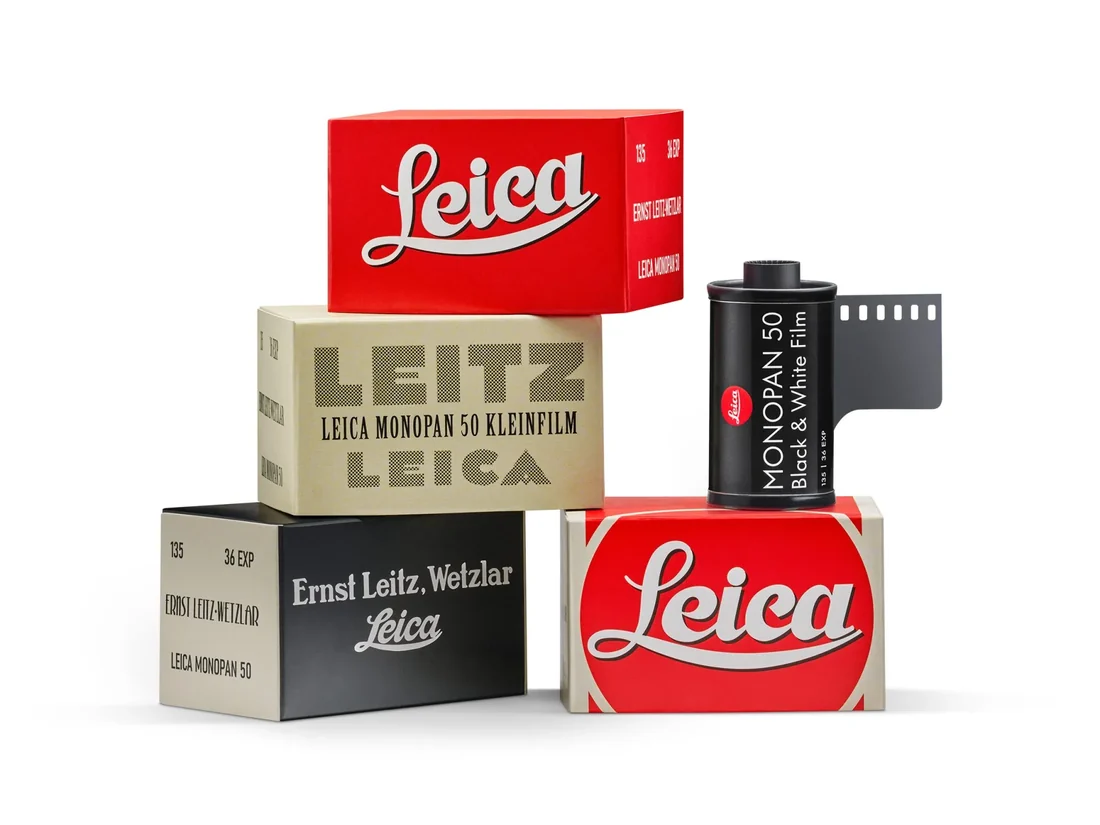
2025 marked exactly 100 years since the Leica I. Leica was not going to let the year slip by quietly. Reaching back to Oskar Barnack's idea of "small negative, big picture," it released the first 35mm film to carry its own name: Monopan 50. The name takes "mono," for a single color, and slyly folds in the Monochrom, Leica's black-and-white digital camera. The boxes even carry the old logo from the Ernst Leitz Wetzlar days and the German word "KLEINFILM" (small-format film). You might wonder whether a roll of film needs all that. Then you see it sitting in a display case and you get it.

But did Leica actually make it?
Something has to be said up front. Leica does not make film itself. What is inside Monopan 50 belongs to the Agfa Aviphot Pan family, a base film originally made in Belgium for aerial photography, with unusually wide red sensitivity. And that base film looks familiar. ADOX HR-50 comes from the very same roots.

Put the two canisters side by side and the resemblance is almost too close. That is why people started asking "Isn't it just Leica on the outside?" the moment it came out. Still, it is hard to say flatly that they are identical. One theory is that the same base film gets a finishing treatment adjusted to Leica's requirements, and some users report that Monopan 50 loses the highlights a little earlier than HR-50. Siblings from the same parents, with slightly different personalities. That is about the right way to see it.
How it shoots
Its aerial-film origins show up plainly in the pictures. A low speed of ISO 50, resolving power that goes up to 280 line pairs/mm, and red sensitivity that picks up near infrared to 780nm, which your eyes cannot see. Put those three together and you get a rather unusual black-and-white.

First, there is almost no grain. Because it is so fine, surfaces stay smooth even in big prints, and detail holds up tightly. The resolution really shows in scenes full of lines, like cities, architecture and landscapes.
Contrast is on the strong side. The tones spread wide and then snap off to white at the bright end. This is not a film that softens things. It renders crisp and hard. Add the wide red and near-infrared sensitivity, and skies sink unusually dark while bright things like frost, clouds and white walls glow silver. Screw on a red filter and the gap widens further.
The catch is that it is slow. ISO 50 asks for honest light. On a cloudy day or indoors you will want a tripod. On a clear day, you can open up a fast lens as much as you like.


The upside of slow
That slow speed is not all downside. You can shoot wide open even in broad daylight, which actually makes shallow depth of field portraits and still lifes easier. And for a contrasty film, skin renders smoothly in soft light.


Developing is easy
No special chemistry required. Pretty much any black-and-white developer works, and home processing is no problem. If you are stuck for data, just start from the HR-50 times, since they share the same roots. The HR-50 recipes on the Massive Dev Chart make a good baseline, for example Rodinal 1+25, 10 minutes semi-stand at 22°C. One tip: this film blows out highlights easily, so meter for the bright areas and do not drag out development.
So, is it worth buying?
If you are being coldly rational, the answer is already in. If this exact look is what you are after, you can get the same picture from ADOX HR-50 or a Rollei-branded Aviphot for a lot less. Monopan 50 sits at the expensive end of the 135 black-and-white films on sale right now: US$10 a roll.
And yet there are reasons to reach for it anyway. The story of the Leica I's 100th anniversary, the four retro-styled boxes, and the satisfaction of loading Leica film into a Leica and shooting it. Film is something you hold in your hand and use, and some objects get priced outside the spec sheet. Monopan 50 is not the cheapest Aviphot, but it is definitely the most Leica Aviphot. If that one line moves you, there is nothing left to think about.
One more thing. As film shooters, we are simply glad Leica decided film is worth selling again. A big name has made more room on the shelf. Whether you care about the packaging or what is inside, that room stays.


