

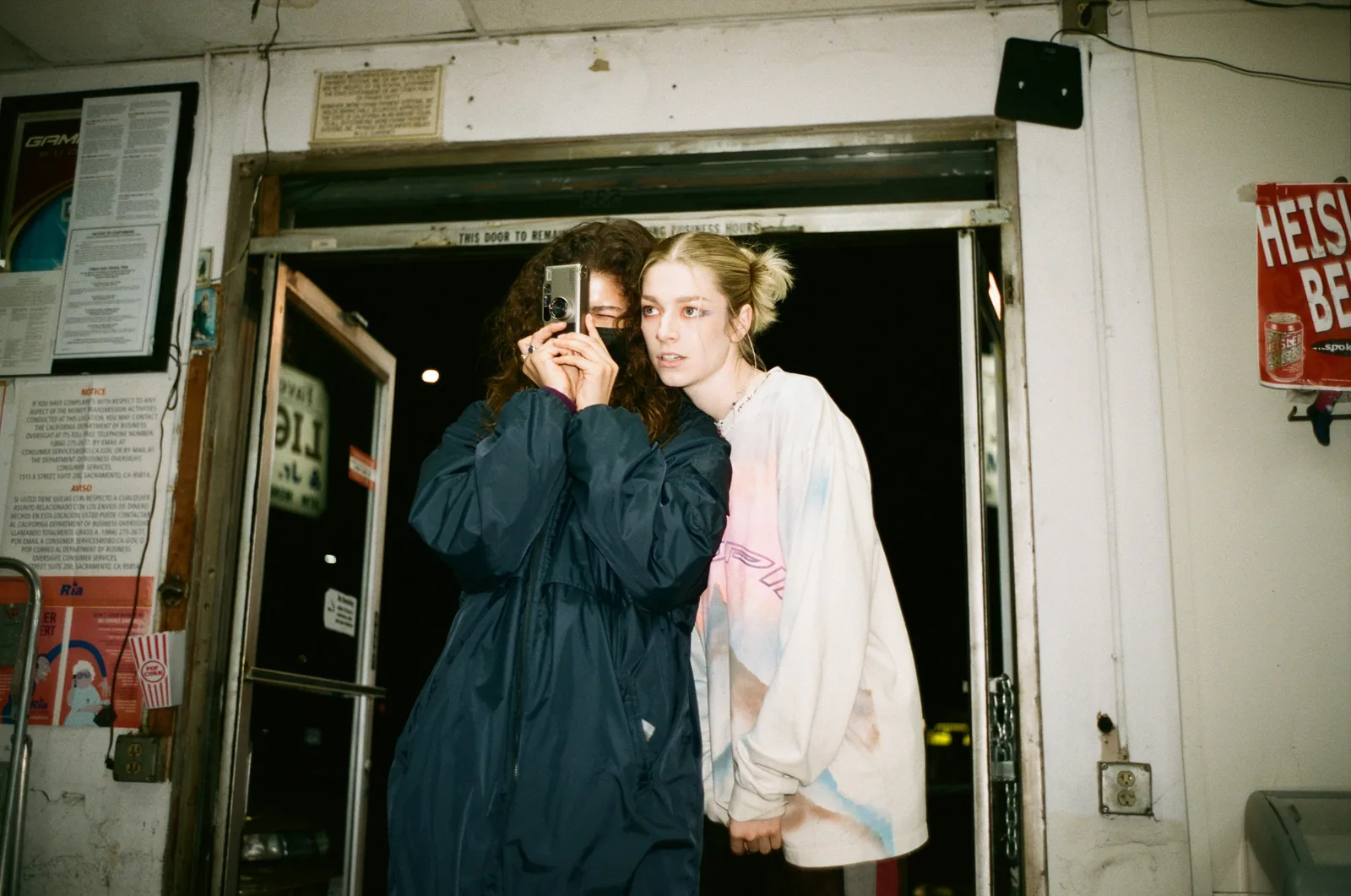
A film or TV set has two kinds of cameras. The motion picture camera shoots the work itself, and the still camera shoots the set. The person behind the second one is called the unit stills photographer. The frames used on posters, the behind-the-scenes shots actors post to social media, and the record that ends up in the archive years later all come from that person.
On the set of the HBO series 〈Euphoria〉 was Eddy Chen. Taiwanese American, based in LA. He does not call his job unit stills. Chen and his agent started using the term embedded photographer. It is not an official job title. They came up with it to describe a different way of working.
Here is the difference. A unit photographer follows the whole production and keeps a record. Chen comes in for the key stretches of the shoot, and in exchange he settles in among the actors, the director and the crew. That is where his pictures come from, the ones where you cannot quite tell a scene from a moment behind the scenes.
The years of safe pictures
It was not always like this. After joining the camera guild ICG Local 600 in 2012, Chen worked on sets like 〈Brooklyn Nine-Nine〉 and 〈Glee〉. What the networks wanted then were correct pictures. Level horizons, straight verticals, the subject facing the camera, a frame that could be used anywhere without trouble.

After a few years he burned out. Advice from Ben Morris, a fashion photographer and his mentor, turned him around.
Shoot what they ask for. But always keep one frame for yourself.
Chen started bringing his own film cameras to set. He tilted the frame, opened up for shallow depth of field, and sometimes blocked part of the lens on purpose. These pictures broke the network guidelines outright. He paid for the film and processing himself.
Then the studios responded to that texture. From then on, film got its own budget line. Film stopped being a matter of taste and became what set him apart from other unit stills photographers.
Euphoria
In 2018 HBO's photo department got in touch with Chen. They had seen the film photos he shot on 〈Animal Kingdom〉 and thought his work would suit the mood of a new pilot with a young cast. That pilot was 〈Euphoria〉.
For Season 1, Chen used Fujifilm digital cameras alongside film cameras. Before Season 2, HBO's request came down to one line: shoot more film.

Because the show itself was being shot on film, the texture of the stills flowed naturally into the look of the episodes. When Kodak added the motion picture color negative VERITA 200D to its regular lineup this year, it put front and center the fact that the stock was developed for the new season of 〈Euphoria〉.

One distinction matters here. The Kodak film Chen used for set stills is made for still cameras. It is a different product from the motion picture stock used on the show. Later, on 〈The Idol〉, he switched to CineStill so that each project would look different.
A knock on the window, a few seconds
There is one image of Zendaya that defines Season 2. It did not come from a poster shoot.
He was outside Rue's bedroom set. Director Sam Levinson and cinematographer Marcell Rév were working out the lighting and framing. Through the window, Chen saw Zendaya standing in the room. He was holding a Nikon F6 inside a blimp, a soundproof housing that muffles the shutter, with a 58mm lens.

He tapped on the window to catch her eye. He had a few seconds. He fired three or four frames in a row, and the one that survived shows Zendaya with her arms down and her head tilted to the side.
Two or three months later, HBO picked that photo as the key art for Season 2. Key art is the lead image that anchors the posters, the trailers and all the promotional material. According to Chen, it was barely touched. They cropped the original and that was it.


The image that becomes the face of a show does not only come out of a controlled studio. When a photographer who knows the set is reading the setup and the actors' brief reactions, that kind of picture can come out of the prep time too.
Never just one camera
Chen's gear keeps changing with the project and the scene. It does not boil down to one camera.
- Euphoria digital stills · Fujifilm X-T5 and X-H2S with Fuji primes. In his view, Fuji color feels less digital.
- Behind the scenes · Contax G2 with flash and black-and-white film. A combination for catching instant reactions up close.
- Scenes in the show · Leica M series. The shutter is quiet enough to shoot while a take is rolling.
- Season 2 key art · Nikon F6 with a 58mm lens, in a blimp.
- Season 2 long exposures · Fujifilm GA645W with flash. Black-and-white frames made with slow shutter speeds and panning.
- Season 1 experiment · Fujifilm TX-2. He borrowed it from actor Jacob Elordi and shot a few scenes with it.
- Commercial and marketing · Nikon Z8 and Z9. He used Black Pro-Mist filters and grain to tame the excess sharpness.
When he started using Leica is worth getting right. He began using Leicas seriously on set after Season 2 wrapped, starting with 〈The Idol〉. His 2023 solo show 「Idol Moments」 at Leica Gallery LA was shot entirely on 35mm film, with Leica MP and M7 bodies and CineStill film. Accounts saying his Euphoria Season 1 and 2 film photos were shot on Leica are not accurate.
Below are the official stills released to the press when Season 2 premiered. Set them beside the film photos above and you can see two kinds of work made by the same person on the same set.


Get it and get out
What Chen keeps coming back to is access and trust, not gear.
Before shooting intense scenes, he first asks the actors how far he can go. Zendaya let him shoot up close from Season 1, and later she kept acting without paying any mind to the camera. Actor Sydney Sweeney has brought Chen onto her own projects and introduced him to other actors.

Having permission does not mean he shoots every take. Once he has the frame he needs, he steps out.
Get it and get out.
He watches the timing instead. Just before an actor goes into a scene, and right after the director calls cut, the emotion is still there. Pictures taken in those moments are hard to tell apart: a scene from the show, or a moment behind it?
Some days he walks onto set with as many as six cameras slung on him. Part of it is to save the time it takes to swap lenses, but it has another effect. Actors and crew ask about the cameras and the film, and conversations start. Those relationships are what let him fire a flash at close range.
I always have four or five cameras hanging off me. It looks ridiculous, but it works. I think it makes me easier for people to approach.
At the same time, he can never hold up the set. He has to respect the workflow of the camera team and the whole production, not just the actors, and he has to know when to get out of the way.
Sometimes the set feels like one big family, and sometimes it feels like being back in high school. I feel like the school photographer documenting all of it.
Keeping the failures
Sometimes Chen spends a whole roll on long-exposure experiments. He presses the shutter without knowing what will come out, and accepts the light trails and the shake as the result.
One of his favorite pictures from Season 2 is a black-and-white frame of Zendaya shot on a Fujifilm GA645W. She is walking a bicycle through what looks like an orchard. He shot it at a one-to-two-second shutter speed with flash, moving the camera to follow her. It was not the exposure he had planned, but her figure held while only the background smeared.
His photo of actor Angus Cloud standing in front of a shop's neon sign was also made with a long exposure and flash. He moved the camera downward so the neon light streamed down over his face. Chen counts these two frames and the Zendaya key art as his defining work from Season 2.


It started with his father's cameras
Chen started taking pictures as a kid with a Nikon and a Mamiya handed down from his father. He left college without finishing, moved to LA and chose to become a photographer. His early pictures were shot on a Nikon D200 with his father's 50mm f/1.4 lens, and his subject was his girlfriend at the time, now his wife.
He reached out to working photographers on Flickr. From the mentors he met that way, he learned how commercial shoots and unit photography work. He remembers being told to pass the help on to the next person, so he still tries to make time for young photographers who ask about the business.
These days he is moving from stills into moving images. He uses imperfect tools: Super 8, MiniDV, the video mode on an old Sony Cyber-shot. Rather than treating his style as finished, he keeps changing cameras and film from project to project.
References
The full interview with Chen is in the video below.
The Photographer who Shot Euphoria, White Lotus & The Idol | Eddy Chen ↗
Sources: PHOTO CINEMATICA YouTube interview (working methods, gear, how the key art was made), BuzzFeed News (number of cameras, the school photographer quote), Leica Gallery LA · SHOOTonline (the 「Idol Moments」 exhibition). Interview quotes are based on cleaned-up English auto-captions, so the wording may differ from what was said. On the key art lens, Chen recalled that he thinks it was a 58mm.


