

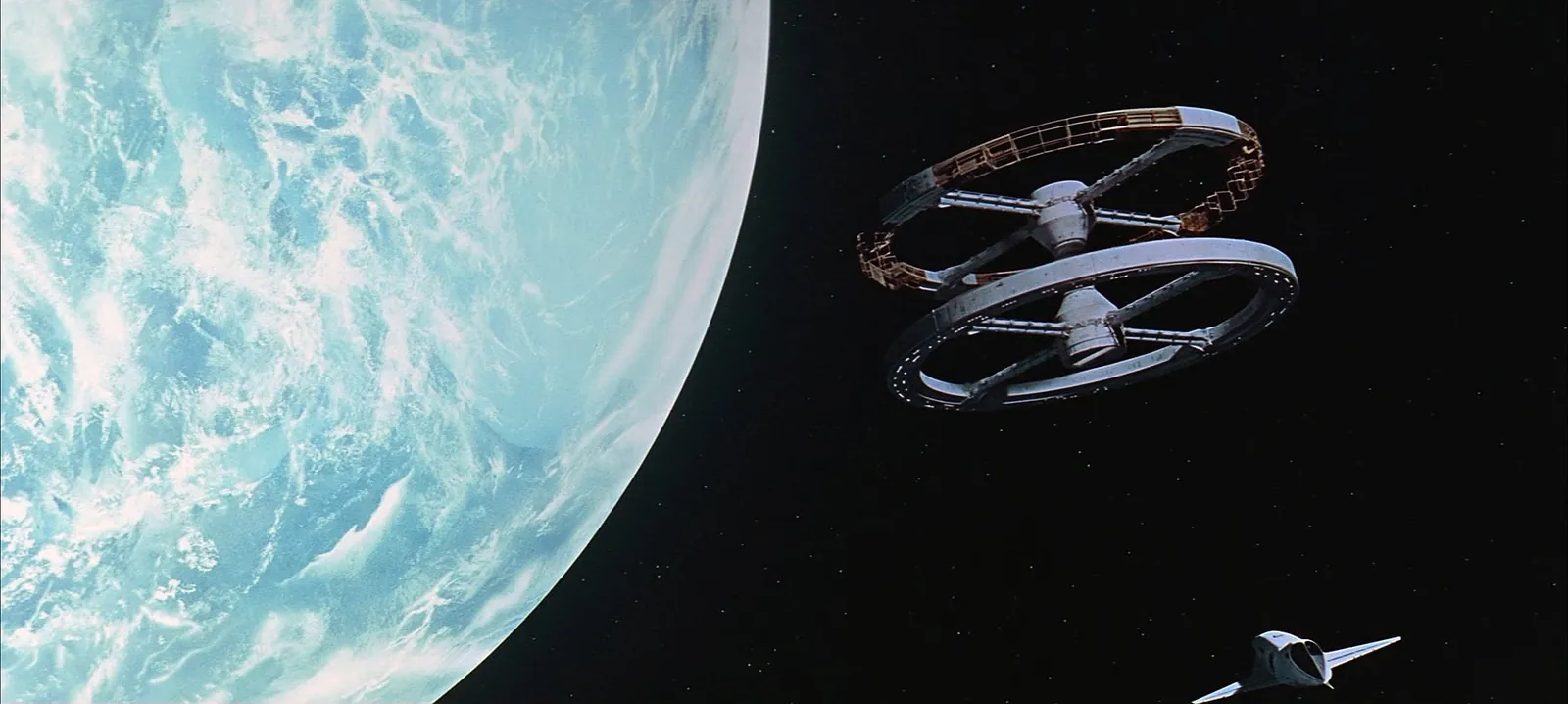
This is a film from 1968, a time when nobody was even saying “computer graphics.” Yet the spaceships and stars of 《2001: A Space Odyssey》 don't go soft when you put them on a 4K screen today. Fifty-eight years later, they still hold up.
Go looking for the reason and you end up at how the film itself was handled. So let's start with what it was shot on.
What it was shot on
The film was shot on Eastman Color Negative 50T, type 5251: tungsten-balanced, rated at ASA 50. The camera was a Super Panavision 70, the stock was 65mm 5-perf, and the cinematographer was Geoffrey Unsworth. Processing was done at the Technicolor lab in West Drayton, west London.
Shooting specs
- Film · Eastman Color Negative 50T, type 5251 (tungsten, ASA 50)
- Format · 65mm 5-perf negative, 70mm release
- Camera · Super Panavision 70
- Cinematography · Geoffrey Unsworth
- Processing · Technicolor London
5251 came out in 1962 and gave way to the 100T 5254 in 1968. The shoot ran from 1965 to 1967, so the timing fits.
That speed of 50 is worth a second look. The slower the film, the finer the grain. Put fine grain on a frame as big as 65mm and you have room to spare, even if the image goes through a few rounds of copying later. The big negative, the slow stock and the duplication method we'll get to shortly all pushed in the same direction.
When every composite cost you quality
Here's how compositing worked back then. You shoot the foreground and the background separately. Then you load those pieces of film into an optical printer and rephotograph them into a single image.
The catch is that this process is copying. Copy film and the grain gets coarser and the contrast turns to mush. Once might be fine, but a shot with several elements goes through the printer several times, and each pass makes it a little worse. It's called generation loss.
That's why spaceship shots in science fiction films of the period looked noticeably dirtier than the scenes around them. Only the composited shots lost quality, so they stood out.


Method one: expose the same film again and again
The 《2001》 crew made some shots with no copying at all. They exposed a single roll of original negative several times over.
First you shoot the spaceship model with the area for the background masked off. You wind the film back to exactly where it started. This time you mask off the ship and shoot the stars or planets. With a rig that repeated the same camera move exactly, the different elements lined up precisely on one piece of original film.
Shots with a moving background worked the same way. With no digital compositing, they shot them like animation, moving things one frame at a time.
It's a risky way to work. If the exposure or position slips even a little, everything already on that film goes in the bin. They really did reshoot the same scenes several times.


The backgrounds on that screen were 8×10-inch Ektachrome slides, originals shot on location in Africa with a large-format camera. Shoot small and enlarge, and the background alone turns to mush, so they shot big from the start.
The problem was heat. Filling a screen that size takes a powerful light, and the heat peeled away the magenta layer of the slides. The fix was water-cooled arc lamps and slides sandwiched in heat-resistant glass.
The star fields weren't made only on film, either. Sometimes they drilled holes in a metal plate and lit it from behind. Sometimes they shot airbrushed paintings on an animation stand.
The sets were built in the same spirit. For the zero-gravity scenes, they built a circular set 11 meters across and actually rotated it. How do you film an actor walking up the wall and onto the ceiling? You turn the set. Whatever could be shot for real was shot for real, which left less to combine later.


Method two: copy in a completely different way
Here's where a common misconception creeps in. You'll hear that 《2001》 looks clean because nothing was copied. That isn't true.
Douglas Trumbull, who worked on the special photographic effects, gave the number himself. More than half the shots in the film were duplicates.
So they did copy. They just took a different road. Instead of copying color film as color, they struck black-and-white three-color separation masters from the original color negative. Red, green and blue each go onto their own strip of black-and-white film, three in all. Those were then combined on a bipack camera printer.
Trumbull explained it himself. All of the duplication was done with black-and-white three-color separation masters, and not a single color interpositive was used to combine shots. He saw that as the main reason the grain didn't build up and the quality held.
Douglas Trumbull, American Cinematographer, June 1968
It's hard to picture from a description alone. Luckily, someone used the same principle a hundred years ago. The Russian photographer Prokudin-Gorsky recorded a single scene three times on black-and-white glass plates, through red, green and blue filters. Stack the three back together and you get a color photograph.


That's what the 《2001》 crew did, only at a different scale. Three rolls of black-and-white motion picture film took the place of three glass plates, and an entire shot took the place of a single photograph.
Color interpositives of the day picked up visibly more grain with every generation. Black-and-white film didn't. Split the color into three strips and handle them as black and white, and even after several rounds of copying the image stays much closer to the original. It took three times the work, but the quality held.
The combining was done on a bipack printer, a machine that runs two rolls of film through one gate, pressed together. One acts as a mask and lets through only the image on the other.


The machine that built a wall of light
None of these methods could produce the Stargate sequence near the end of the film, a corridor of light that fills the screen and keeps rushing at you. So Trumbull built a machine for it himself.
It's called slit-scan. Here's the idea. Stand a long, narrow slit in front of a backlit piece of artwork. With the shutter held open, push the camera toward the slit as it shoots. During the exposure of a single frame, the light coming through the slit stretches across the film into a line. Repeat that frame by frame, shifting the position a little each time.


Each frame took several seconds. Getting the whole sequence took months. This is what came out of it.

Everything else they layered on
These two methods weren't the whole story behind the image quality.
What protected the image
- 65mm negative · holds a different order of information than standard 35mm
- Front projection · with mechanically controlled cameras, live-action foregrounds were joined to high-resolution backgrounds in one frame
- Frame-by-frame mattes · the areas to be masked were made by hand, one frame at a time


There was one goal: make the composited shots look as if they had simply been photographed. A picture that looks like it never went through a single generation.


For this work, Kubrick won the award for Special Visual Effects at the 41st Academy Awards in 1969. It was the only Oscar he ever won in his own name. He skipped the ceremony, and Diahann Carroll and Burt Lancaster accepted it for him.
So what about 4K?
Strictly speaking, 4K is a pixel standard for digital screens. This film was shot on 65mm film, and film has no pixels. The two units measure different things to begin with.
Look at how the 2018 4K release was made and the relationship gets clearer. The 65mm original camera negative was scanned at 8K and then brought down to 4K. Christopher Nolan and cinematographer Hoyte van Hoytema oversaw the work.
It started with cleaning the negative by hand and removing old splices. That year the work came out in two forms. One was a 70mm theatrical print with no digital touch-ups. The other was a 4K HDR master made from the 8K scan. Neither one redid the effects or changed the edit.


4K was never the limit of the film. The film held more than that.
That's because, 58 years ago, someone shot it on a big negative and chose a way of copying that didn't add grain. Back then, nobody had heard of 4K.
